Guidelines describe; a system enforces. Tokens, written laws and a linter replace the brand police — nothing off-canon can ship, in any hand, on any surface. The look survives growth.
TOKENS · LAWS · LINT · 0 ERR / 0 WARN
02 · RULES AN AI CAN RUN
Written law is machine-readable law. An AI composes new pages inside the canon, draws the diagrams from measured data, and polices itself — design capacity that scales without diluting.
AI-OPERABLE · SELF-POLICING · SELF-EXTENDING
03 · YOUR BRAND DNA IN
Faces, inks, grid, voice — swapped at the token layer. The same engine becomes your system, or a new brand’s first one. This site is the proof: our own DNA, run through the method.
JACOB@INTELLIGENCEMATTERS.SE
000_system
Once it is built, the system runs the brand — unsupervised.
A brand book is a set of instructions for people — and instructions decay the moment the people change. A coded design system is the brand written as rule: type, layout, components, mail, slides, the web, the AI-generated asset — every output runs against the same logic, so it returns the same brand whether a person made it or a machine did. We author the system once, by hand, at the level of taste; after that it holds the line itself, across everything, with no one in the middle redrawing or policing it. The work was the thinking. What ships is a brand that keeps itself.
Build on it
One page, one system. This weblink is the full register — agency showcase, canon apparatus, grammar ledger, and HUB register on a single stylesheet. epoq3 is hosted, not copied. One line in any page's <head> makes that page part of it — every token, type role, bare HTML layer, container grammar — and it auto-updates when the system ships:
Add the two webfonts, write semantic HTML, and ship. Raw h1–h6, p, ul, table, blockquote render on-canon with no classes. Reach for container-tile, serif-body-1, mono m6 when you want a specific box or voice. For every legal pattern and editorial instrument, open 009_writing — the full canon in one place.
The one law
Always link the live weblink; never paste a frozen copy of the system into a page. A pinned copy forks the moment the system moves and silently goes stale — the disease this repo was built to kill. The linter (canon-lint.py, E21 FROZEN-FORK) trips on it, so it cannot ship.
To check a page: python3 ~/epoq3/canon-lint.py yourpage.html — it reads E1–E23 and names the exact line where you drift. Green is provably on-system.
001_tokens · containers
System tokens — if it is reusable, it becomes a rule. Spacing is structure; containers are the only box. Nothing floats by eye.
The viewport · 1280 — the grid lives inside the container · 3 × 400 + 2 × 40 · every gap on --s-1…6
400 · --col
40
400 · --col
40
400 · --col
the spacing spine8 · --s-116 · --s-224 · --s-340 · --s-4 · the atom = --gutter80 · --s-5120 · --s-6
Container widths · the only three — each an outlined box at true width · widths ONLY 400 / 840 / 1280
Same mechanism as [data-density="tight"], already used on #ohm and #rendering-hands — a section boundary and a sub-block boundary read at two visibly different heights.
THE WOUND · the lawful interruption — one per composition · it must carry meaning · every displacement a spine measure · the captions align by subgrid
THE BLEED — the field runs past the sheet's rule by a measured inset; the sheet cuts it at the edge
THE MISREGISTER — the pass prints off-register · one step right, half a step up · never freehand
THE RESERVE — the held white; the space is kept and nothing may fill it
onegatheringwraps
THE GATHERING — the named cluster · wrap · gap · align — already canon as the control row; named here
the woundbleed · misregister · reserve — one per compositionthe gathering rides along · measured, never freehand
001 · the measuregrid · spacing · containers · viewports — drawn to scale above, not re-listed80 is the subsection breath · 120 is the section breath · the container is the only box
002_type
Six voices from Figma 653:363 — Scheherazade for prose, Red Hat Mono for the machine. Each specimen measured, not asserted.
Paper and the working family — ink for prose and code; button and pill hold graphite (#272727). Grey and two violets for borders, fills, and signal. Colour is never an ambient field.
The palette · paper + ink + graphite + grey + two violets · light → dark
Paper#FFFFFF—
Ink#000000—
Graphite#272727—
Grey 51#515151—
Dusk#5F5295—signal only
Hum#6F75D7—signal only
The signal instruments · strong, dark-stage-only, added onto the palette 2026-07-10
Signal · Go#8E00FF—field success · signal only
Signal · Live#2CFF05—the matrix green · dark-stage only, never on paper
The palettepaper + ink + graphite + grey + two violets + two signal instruments · OKLCH · light → darkHum + Dusk are signal colors only: live, linked, selected, canonical.button + pill · graphite #272727 · paper on ink-fill onlycolour is an instrument, never a field
004_hub
Atoms first — pills, dots, badges, warmth, chips, buttons. Rows carry the work: cards, streams, signals, presence. Glass rides the motion ramp for agency only. Authored in hub-atoms.json, compiled by the press.
Every atom is designed once, before any row exists — a pill or a dot means the same thing wherever it lands, so a card, a stream, or a glass instrument can borrow it without redrawing it. 46 parts, one stylesheet, and nothing recomposed twice.
100_atomsThe smallest chrome primitives — pills, dots, badges, warmth, chips, buttons, and labels. Design these before rows. — 22 parts.
Pills
default
print square · serif 8 · +20% track
ghost
graphite fill · paper text · no border
accent
signal-go border
attention
signal-attn border
filled
ink fill · paper text
Square dots
L0–L5 · ghost → solid
L4 hum · solid
L4 · ripple 2.4s · ghost
File / status badges
polished
solid dot
draft
ring dot
locked
struck ring
Filter chips
serif 8 · ink-03 hover · square
ink fill · paper text · square
Buttons
ink fill · hard flip · serif 8
paper · line-box border · serif 8
glass tint · square · blur
disabled attr · ink text
Labels & meta
Section header12 live
mono caps · meta right
A note with the left ink anchor — measured, not asserted.
2px left rule
OwnerJacob Hägg
key 80px · val serif
THE SHELF-MARK · the address a part carries
005acc.0001tier 200
dept · accession · slot — the real acc.0001 address; accession.py's Phase-5 vocabulary, minted 2026-07-10
THE FOLIO WALK · prev · folios · next
links, so the keyboard walks it by nature · the current folio prints solid
Motion register · Figma GFVDHzPgeMjx4KSkjyW4NE · four instruments at hub scale
300_controlsdesign/system/RULES.md §4's six-component operational set, closed onto the token spine. Four — Chip · Card · Pulse Dot · Warmth Bar — already live in 100/200 above and carry over as-is, not re-shown here; only the two the §4 set adds beyond them render: Segmented Control and the slotted List Row. — 2 parts.
Segmented Control
RULES.md §4 Segmented Control — a row of Chips filtering in-view, distinct from Tabs
List Row — leading · main · trailing
Canon refinery — token drift review2d
RULES.md §4 List Row — leading pulse-dot · main prose · trailing meta, py-3
400_glassciCut for the company hub — the record is drawn in characters, agency floats on glass, the bones are presence, the prompt is the door. — 7 parts.
┌─┤ SIGNAL LOCK ├──────────────────────────────────────────────────────────────────────┐
│ ONE HEADLINE — DECLARED, NOT DERIVED                                                 │
│ TRACK A · target —      TRACK B · target —      TRACK C · target —                   │
└──────────────────────────────────────────────────────────────────────────────────────┘
┌─┤ DRIVING ×3 — declared, never derived ├─────────────────────────────────────────────┐
│ ● PROJECT ALPHA   #101   [P5·OP1]   ▮▮▮▯   today                                     │
│     next: ship the one thing                                                         │
│ ● PROJECT BETA    #102   [P4·OP2]   ▮▮▯▯   1d                                        │
│     next: name the next element                                                      │
│ ○ PROJECT GAMMA   #103   [P4·OP1]   ▮▯▯▯   3d                                        │
│     next: close the loop                                                             │
├─┤ OWED — derived from the record ├───────────────────────────────────────────────────┤
│ 0000-00-00   the promised thing, to the named person     OP2   −2d                   │
│ 0000-00-00   the second promise, still breathing         OP1   due                   │
└──────────────────────────────────────────────────────────────────────────────────────┘
  OWED derived · DRIVING declared ≤3 · GARDEN unranked — by design
Terminal design — monospace spine, live code telemetry. The wildest instruments from the register, composed for command-line surfaces.
Soft glass, hard terminal. REPL spine with a lawful cursor — the muse reads through the dark stage; the receipt rack widened into its own live, filterable instrument; a status line and a log-levels stream carry the terminal's own language; the session is a terminal on paper. 5 parts · cli-terminal.js drives motion.
CLI register · repl · instrument rack · Glassmorphism with a terminal injury
1 · REPL → command-line spine
hhg@cortex·scout-run
›▌
Acrylic skin. Command-line spine.
2 · Rack → code telemetry
> EPOQ_RACK_PATCH ( "005_cli", live )
Live code telemetry. Filter · ping · hover to pause.
005 · clirepl · receipt · status · log · the sessionpress-cli.py · cli-terminal.js
The terminal language — the status line + the log-levels stream, on the dark stage
the status line — mode · path · branch · counts
NORMAL~/cortex⊒ main3 lanes14:22
the log-levels stream — ok · info · warn · err
okbuild passed · 0 errors · 148 tokens resolved
infoaccession #14 · THE LINE sequential, in sync
warn2 hatches signed · canon-lint:allow
err1 containment breach @ ≤400px · held
005 · terminal languagestatus line · log levels · the dark stage
The session · a paper terminal
op@epoq3:~$ why-a-registerA system that isn't machine-readable can't be operated, only described.So nothing here is freelanced — every part traces to a ticket on THE LINE.The record over rhetoric.Measured, never performed.op@epoq3:~$ ▌
the sessiona terminal reads on paper too — the register is about being a terminal, not the stage under it
006_identity
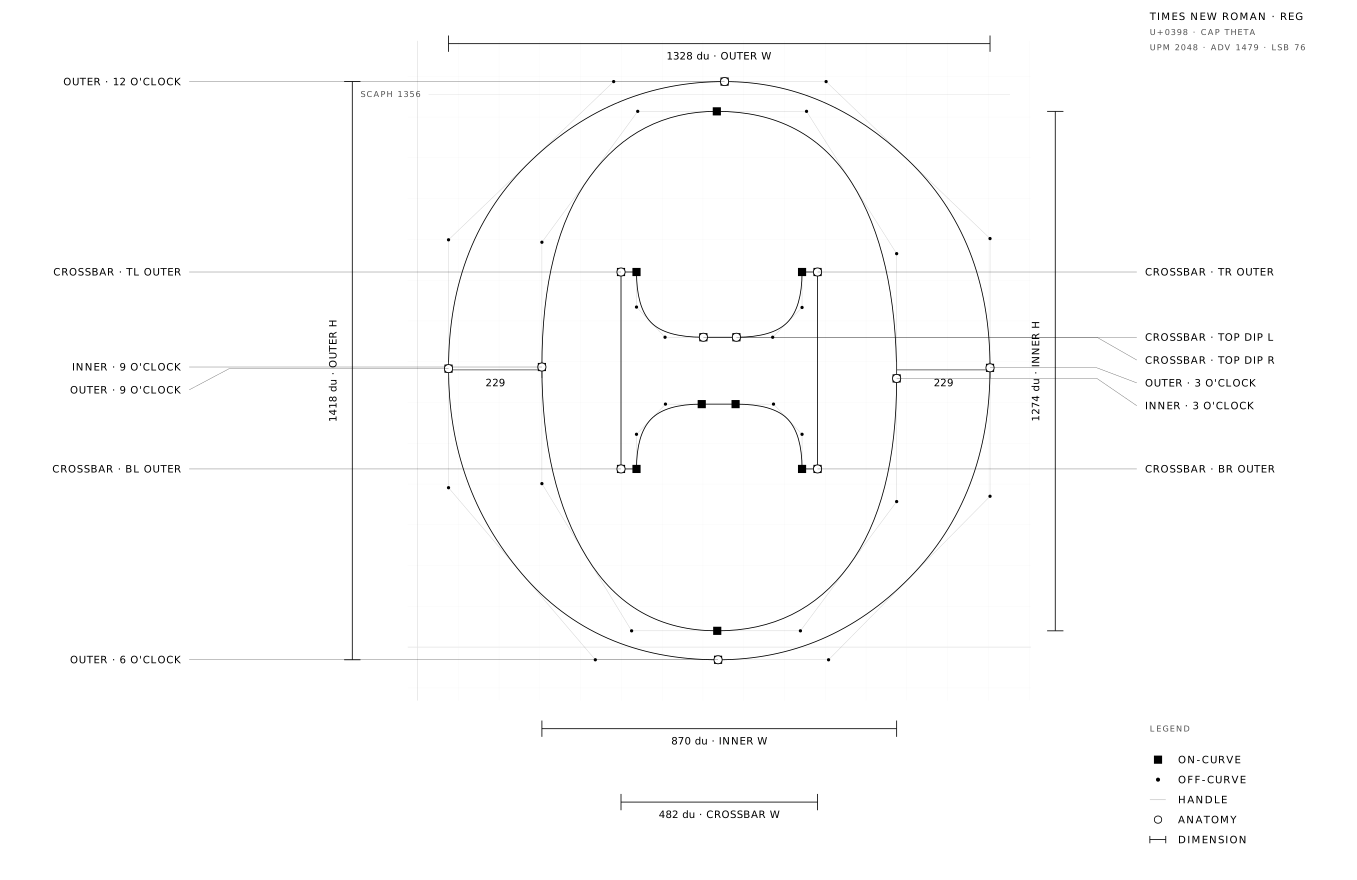
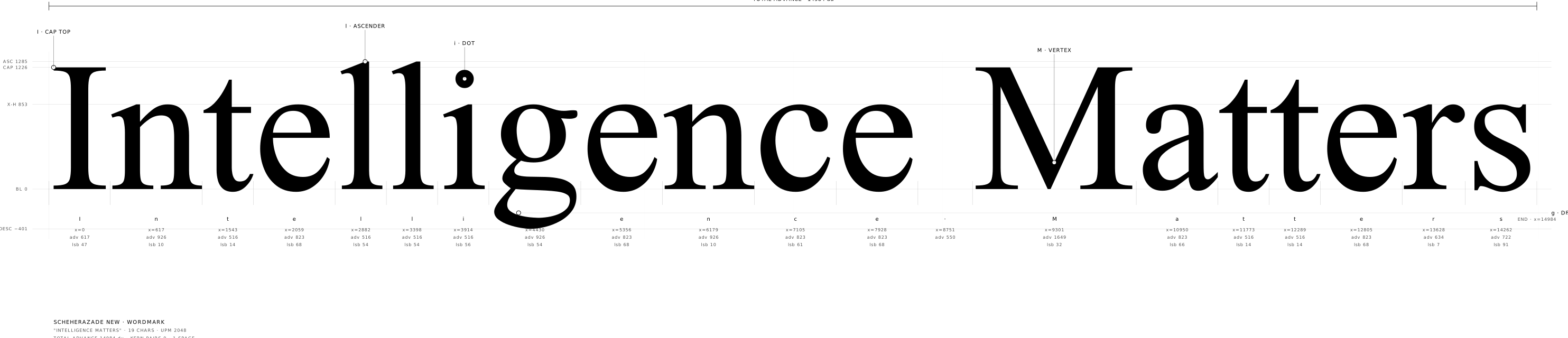
The wordmark register — one name, four faces. Text, stack, glyph, drawn. Then the measured truth beneath two of them: the Θ mark and the wordmark drawn from the real font outlines. Every face is a specimen; nothing is a logo file.
wordmark · constructionScheherazade New · UPM 2048 · 19 chars · total advance 14984 du · asc 1285 / cap 1226 / x-height 853 / desc −401
007_site
Website components — the card, the editorial row, the signup, the caption atom, THE CONTENT TILE, THE TUNER. Working specimens, assembled from the register.
the storeroom
Everything at stage cooking
The index holds the whole abundance; a part reaches the wall only by an accession. This is the narrative tile — auto-height, the image sets its own aspect, the text runs long.
Image
the specimen
the focal law
Design
the token spine
the wound
Code
the press
the gate chain
the content tilestory · specimen · list — the same three primitives (m-stage · specimen · med-text), three shapes
Site Tuner
9096102
STANDBY
TUNED IN
the tunerprint register, not glass · a station reveals only once tuned
the pulla full-width CTA for an external link-out — label · meta · arrow, folds to two rows under 919
Sign up to Intelligent Feed
signupreal form · native validation · no backend — the note tells the truth
end to end protocolend to end protocolend to end protocol
caption atom160 × 20 · hairline · the info strip
the site registerthe canon site footer — braille reading-line (aria-hidden · 2× mono · lh 1 · 3-word cap) · the grease-pencil ring on the live section (ONE drawn oval, JS-drawn stroke — E6-lawful motion) · live position · dormant marks ink-12 → ink live · fixed in use, in-flow here · baselines measured per element, never transferred
008_theatre
The anatomical theatre — the system demonstrates on its own body. Coded numbers, exposed seams, variant readings, a man page, and the newest CSS held under the old laws.
P1jacob live
#18The exposed seam
Hover this card — its construction is the content.
hairline 0.5 · the top seampadding s-2 · type mono-6 + serif-body-1 · tick 2px attn
the seam mapdeconstruction as intelligence — the atom H-201 with its seams exposed on hover
The system holds nine inks six inks [β] and one stroke. What is struck is not deleted — it is kept, legible, under the line. The apparatus records every reading it refused [α], and the page carries its variants the way a garment carries its seams: on the outside.α · the refusal is part of the record
— the writing
the variant readingthe clinical strike — hover restores the struck reading · drop cap · marginal sigla · the catchword anticipates 010
EPOQ(3) HHG Design Manual
NAME
epoq — the rigid visual system
SYNOPSIS
<link rel="stylesheet" href=
"https://epoq3.vercel.app/styles.css">
DESCRIPTION
One page. Six voices. Seven inks.
The container is the only box;
the hairline is the only stroke.
OPTIONS
--col 400 --col-2 840
--content 1280 --gutter 40
--hairline .5 --section-gap 120
SEE ALSO
001_tokens(3), 002_type(3), 004_hub(3)
man epoq(3)the linux page — the manual is the voice the terminal already trusts
008 · theatrethe cut · the seam map · the variant reading · man epoq
009_writing
Semantic HTML and editorial apparatus — the six voices are canon in 002_type. Bare tags render on-canon; the ledger names rhetoric, refs, and lawful patterns.
Codex 011praefatio — the established register, one page before the apparatusfol. 10 · verso
See 002_type / Italic · Bold · Body. Footnotes hang from superscripts. The link mark is the partial, borrowed from the symbol voice (fig. 3)Six voices · Figma 653:363 · code +30%: ∂ 001_Tokens. A reference under the cursor opens as a liquid-glass note — the material’s first duty on this page.
A revision keeps both readings — struck, not deleted: what was the storeroom the floor stays legible under the line, the static form, always visible — no hover required to read the record.
[1]Intelligence Matters (2026). The rhetorical typography canon (D-030) — roman states · italic the tism · bold the explainer.
IN WHICH the page reads itself entire; a theorem is proved concerning the stroke; the apparatus records what was struck and by whom; a plate is engraved in character; and the terminal, having kept the minutes throughout, exits cleanly.
The page, having been compiled at dawn and found lawful, permitted itself one chapter of reflection; and if the reader detects in what follows the manners of an older century — the epigraph, the argument, the plate — let it be recorded that the terminal kept the minutes, the mathematics kept the law, and nothing was ornamented that could instead be proved. The house signs itself IM; its one interruption is ^C — and even that returns the prompt.
Theorem 011.1 (the hairline limit). Let W be the set of admissible strokes. For every ε > 0 there exists exactly one w ∈ W with |w − ½| < ε; hence W = {½}. Proof. The system admits no second weight by construction; any candidate w′ ≠ ½ is flagged at the gate and refused under E10. What remains is the hairline1. ∎
The reader is furnished, in the customary manner, with:
one epigraph, taken from the log — stdin for a chapter;
Zero-padded, because the machine reads from the left.
PLATE I. — THE LENS
      ┌─────────────────────┐
      │      ·  ·  ·        │
      │   ·     Θ     ·     │
      │      ·  ·  ·        │
      └─────────────────────┘
      stroke ½ · scale 4:1
engraved in character — the plate costs nothing to print and survives every format war
Raster
The moment a letter agrees to become pixels.
Reflow
The page rethinking itself without telling anyone.
Variant
A reading the canon refused but kept — struck, dated, legible.
Epigraph
What an older century called stdin.
The record over the rhetoric — a coded system returns the same brand whether a person made it or a machine did.
The design-system canon
TABLE I. — the working family, as measured
Ink
Hex
Role
Paper
#FFFFFF
the ground
Ink
#000000
the text
Dusk
#5F5295
signal only
Plate II — withheld
The second engraving exists and is deliberately not shown; the reader is trusted with the first.
Lemma 011.2 — folded
Every gap is a multiple of the atom, or it is not a gap but an accident. The proof opens without rotating anything — stillness holds (E6).
1 Not asserted — measured: canon-lint (E10) refuses a second weight in source; system-guard proves the rendered stroke at the gate.
Codex 011the invented register — the four voices proved one (cont.)fol. 11 · verso
It will be objected — and the objection is filed, struck, kept — that four voices in one paragraph is three too many; that a house should choose the novel or the proof, the terminal or the customary manner, and hold its tongue in the other three. The house declines. A single voice is a single face, and a single face is a reduction — it shows the reader one plane of an object that has four, and calls the omission taste. Here nothing is omitted to look calm.
Observe the paragraph you are reading. It carries a reading — the sentence you follow to its stop. It carries an apparatus — the folio above, the siglum beside, the footnote below, each recording what the page knows about itself. It carries the terminal — the minutes, kept — and it carries a proof, for every measure it names can be checked at the gate. Four registers, one register: this is the invention, and it has no name older than this codex, so the codex gives it one.2
Corollary 011.3 (no honest single voice). Let a text T address an object with four faces — reading, record, machine, proof. If T speaks in one register it renders one face; the other three are asserted, not shown; hence T is unproven on ¾ of its object. Only the four held at once leave nothing asserted. Proof. By construction, and by the law that follows overleaf. ∎
So the chapter ends as it was compiled — at dawn, and found lawful. The terminal, having kept the minutes throughout, returns the prompt; the mathematics rests its case; the apparatus files its last variant and closes; and the novel, which carried you here, sets its final stop. What follows overleaf is not another chapter but the law the chapter obeyed — extracted, numbered, and made to govern every text this house will ever set.
$ chapter --close XVIII
  novel      ✓  the reading delivered
  apparatus  ✓  every variant filed
  terminal   ✓  minutes kept, prompt returned
  proof      ✓  nothing asserted
exit 0
the four registers close together — a chapter is done when all four sign off, not when the prose stops
2 The house calls it the invented register: not a fifth voice added to four, but the discipline of sounding all four at once. Named here, fol. 11 · recto–verso; ruled overleaf.
Codex 011THE FOUR-REGISTER LAW — the rule for every IM textfol. 12 · recto
Hold all four, or you have shown one face and called it the object.
the law, in one line
THE LAW.
EVERY text Intelligence Matters sets is written in four registers held at once — the novel, the apparatus, the terminal, the proof. Not four to choose from; four to sound together. A text in one voice is a reduction, and this house does not reduce to look calm.
The registers are not styles. A style is a coat a text puts on; a register is a duty a text discharges. Below, the four duties — each stated, then measured against the same object, so the law is not described but performed. Read the table as the specification; read the page around it as the proof that the specification holds.
TABLE II. — THE FOUR REGISTERS, as ruled
Register
The rigid rule
Carrier
Duty
Novel
A person can read it end to end as prose.
serif · roman · the running sentence
carries the reading
Apparatus
It shows its provenance and what it struck.
folio · footnote · siglum · margin
keeps the record
Terminal
Where the system acts, it speaks as itself.
mono · exit 0 · the log line
keeps the minutes
Proof
Every figure that can be measured is measured.
theorem · table · ∎ · the gauge
proves the law
Theorem 012.1 (the fusion law). A text is of the house iff it sounds all four registers at once. Proof. The terminal keeps the minutes; the mathematics keeps the law; the apparatus records what was struck and by whom; the novel carries the reading. Remove any one and a face goes dark — ¾ stands, ¼ is asserted; and the house admits no asserted quarter. What remains, once the four are held, is a page on which nothing is ornamented that could instead be proved. ∎
One sub-law is inherited whole from the type register1: the roman states, the italic carries the single lean, and the bold explainer never stands in running text without its glass. That law governs the sentence; the four registers govern the page; together they leave no altitude unruled.
$ im-lint --registers  draft.txt
  novel      ✓    apparatus  ✓
  terminal   ✓    proof      ✓
  → of the house.            exit 0

$ im-lint --registers  clean-copy.txt
  novel      ✓    apparatus  ✗   no record, nothing struck
  terminal   ✗    proof      ✗   three faces asserted
  → reduced: 1 face shown of 4.  exit 1
the law is checkable — a text passes when four registers sign, and fails, loudly, when one is missing
This is why an IM text cannot be clean marketing copy — clean is a reduction, three faces asserted. It cannot be a bare specification — a spec has no novel; nothing carries the reader. It cannot be a story alone — a story has no proof; nothing holds at the gate. The four together are the register; the register is the house; the house is IM. Set every text this way, or set it somewhere else.
1 The rhetorical sub-law — roman · italic · bold — is canon in 002_Type and older than this folio; the four-register law does not restate it, it stands on it.
The writingvoices canon in 002_type · writing = semantics · rhetoric · apparatuspraefatio first · live demo · the register in usegrammar.json is canon · grid + containers → 001_tokensitalic is the tism · bold only behind glass
010_ohm
A signal instrument — pulse, breath, prime, binary, and live-state behavior. Not a layout primitive; used when the system needs energy, continuity, or measurement.
Ohm — primes2 → 89 · binary passesbinary → the nameThe numbers learn to say Intelligence Matters
Θ
Ohm — held4.5s breathΘ · held
The read, applied — project cards · hover: the head reads the record · the record lives outside the markup (.md / db row)
Record 01 · IM-2026-011
The artefact and the aura
Nº · year · chars · read ms
Record 01the numbers first · then the record
Record 02 · IM-2026-024
Distance
Nº · year · chars · read ms
Record 02the numbers first · then the record
Record 03 · IM-2026-038
Proof beats posture
Nº · year · chars · read ms
Record 03the numbers first · then the record
901 · ohmpulse · breath · prime · binary · reada signal instrument, not a layout primitive
011_rendering_hands
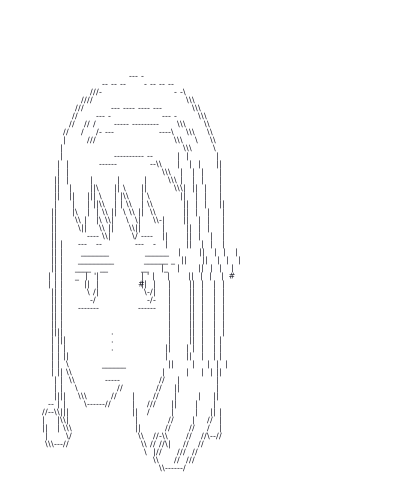
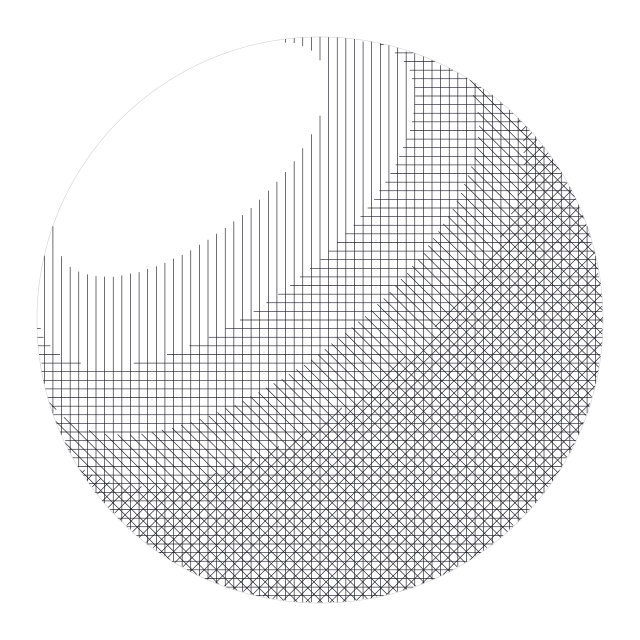
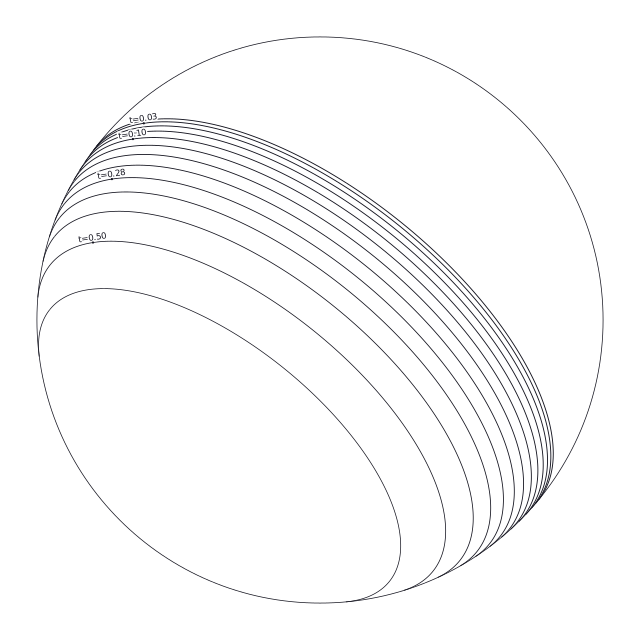
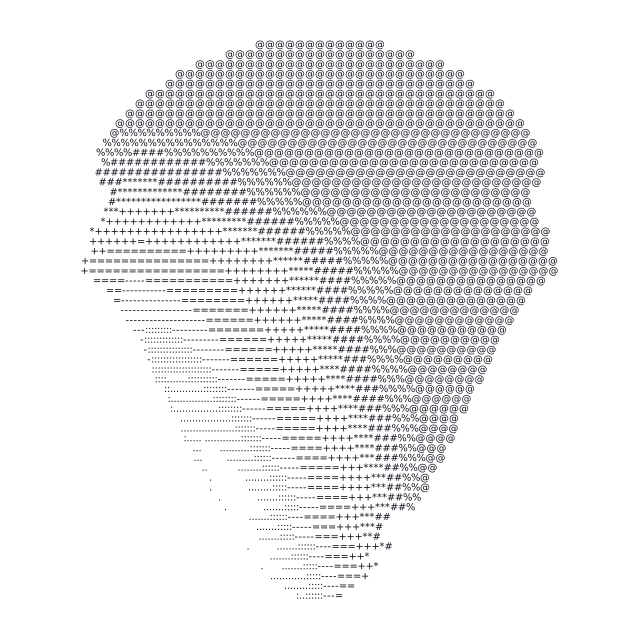
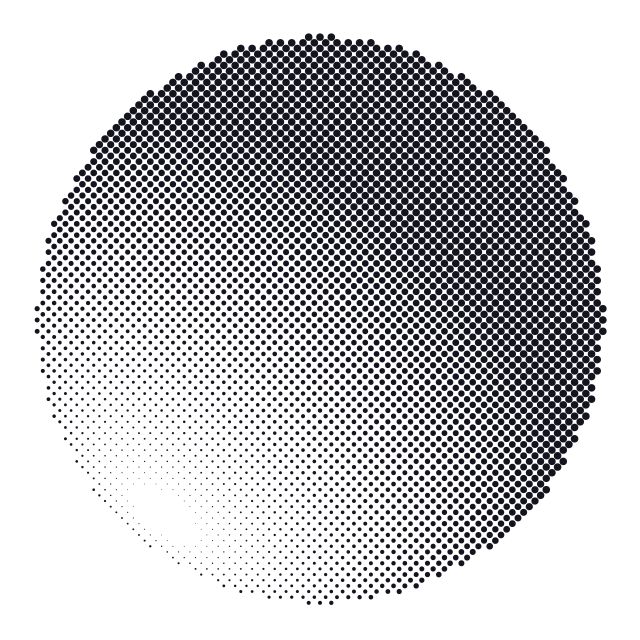
How image, surface, texture, glyph, contour, hatch, raster, moiré, halftone, and negative-carve treatments behave inside the system — one subject, many hands, the same sphere so the hands compare honestly.


Snippet, then the body, then the verdict — a comment is a small ruling.